
Better Stack (Part 2): Why Technological Sovereignty Needs a Venture State
This article is authored by Manuel Kilian, Managing Director, Global Government Technology Centre Berlin.
Europe's sovereignty debate focuses on policy. But the deeper problem is corporate: European firms have not built the economic moats that could translate into geopolitical leverage. Other powers have found ways to support moat-building through state action. Europe has not. Developing that capacity is the task of a new governmental logic: the Venture State.
This article is the second part of the 'Better Stack' series. In part one, Ansgar Baums and I set out ten theses on the challenge of digital sovereignty in Europe. Over the past months, we have discussed these ideas extensively. What follows is our joint synthesis, with the intention of adding further to the debate.
At the heart of part one was a strategic shift: moving away from trying to replicate tech stacks altogether, and towards establishing intelligent interdependence — by becoming indispensable within the Western digital ecosystem, not isolated from it.
Two of those ten theses are foundational for what follows here:
Thesis 3: Europe must become indispensable within the Western IT stack. The more technologies Europe builds that others rely on, the stronger its leverage.
Thesis 4: Indispensability comes from bold bets on next-generation technologies, not from duplicating existing ones.
This article returns to these two theses because they remain underexplored. They describe what Europe must do. What follows addresses how, and why it has not happened: Why have European companies failed to build strategic positions that make them indispensable? What kind of policy environment has failed to support them? And what must governments do differently?
The answer unfolds in three steps. First, it introduces economic moats, or sustainable competitive advantages, as a lens for understanding technological leverage. Second, it diagnoses why European companies have failed to build moats, while US and Chinese competitors have. Third, it outlines what kind of state is needed to close that gap: a Venture State, a model of governance that builds capacity through many early bets, fast iteration, and strategic scale.
Why Moats Are the Real Sovereignty Question
The Moat Framework
To operationalise the idea of IT stack indispensability, it helps to look at it from the point of view of sustainable competitive advantage, or, as Warren Buffett famously described it, ‘moats’. Buffett invests in companies with wide moats, easily defendable against competitors. Morningstar, the financial services firm, has developed this into an analytical framework, identifying five sources of moats:
Intangible assets: Patents, brands, and regulatory licenses that prevent competitors from duplicating products or allow premium pricing.
Switching costs: Barriers that make stopping use of a product too expensive or troublesome for customers to switch.
Network effects: The increasing value of a service for consumers, suppliers, and developers as more people use it, particularly prevalent in platform markets.
Cost advantages: The ability to provide goods or services at lower cost, allowing firms to undercut rivals or achieve fatter margins at the same price.
Efficient scale: Markets with limited size where potential competitors have little incentive to enter because doing so would lower returns below the cost of capital.
Morningstar considers a corporation as having a wide moat if its competitive advantage is expected to last more than 20 years, a narrow moat for 10 to 20 years, and no moat if the advantage is transient or nonexistent.
Why do moats matter? Because moats enable companies to generate sustained high profits and own key positions in value chains. The club of wide-moat companies is rather elite: In 2024, approximately 17 percent of companies in Morningstar's coverage qualified as wide-moat: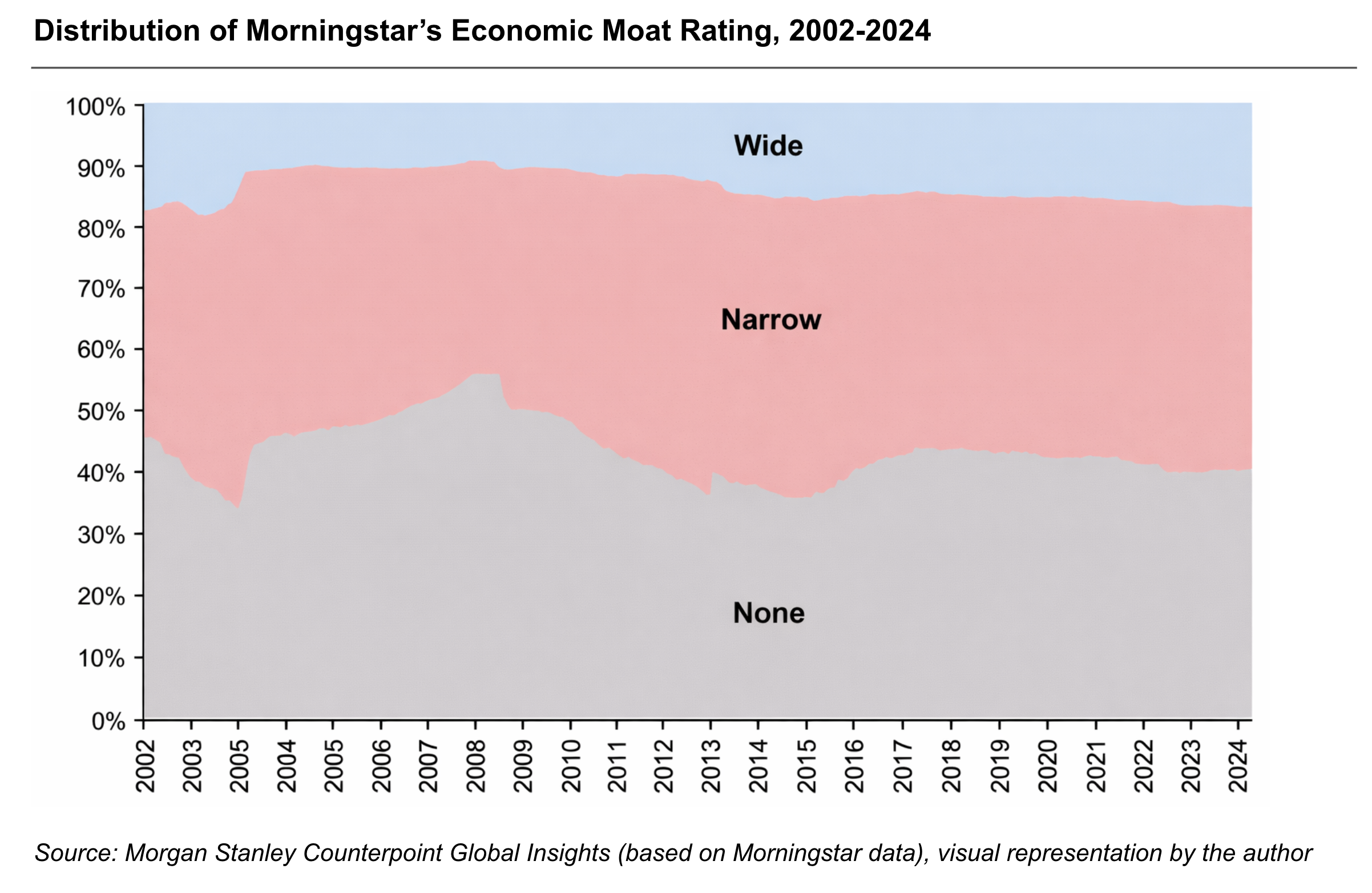
Understanding Moats as Geopolitical Assets
The moat concept originates in business strategy. But moats have become geopolitical assets. Consider the companies that now feature in geotech statecraft: ASML, Google (Android), Nvidia, SAP, TSMC, Trumpf, Zeiss. All are wide-moat companies. Their competitive advantages translate directly into strategic leverage. When a company is indispensable to global value chains, the government that can influence it holds a card in geopolitical negotiations.
A nation with many wide-moat companies has options. A nation dependent on others' moat companies does not. This is why moats matter for sovereignty. And moat ownership is not solely a function of high-tech or R&D spending: China's dominance in rare earths processing, built through cost advantages and efficient scale rather than technological sophistication, shows how moats can be created at any point in a value chain.
Why Europe Has a Moat Deficit
Europe's failure to build moats is often described as a policy gap. However, we believe this gets the causality backwards. The sovereignty debate is a symptom of the underlying problem, which is a failure of corporate strategy on a continental scale. For roughly three decades, Europe has produced too few firms that have turned technological advantage into a lasting competitive edge. Rather than asking “Why is EU policy weak?”, we should be asking “Why does Europe's corporate system systematically fail to create moats, and what can policy realistically do to change those incentives?”
Four structural barriers explain the moat deficit. Two are familiar but still decisive; two are deeper and more original to Europe’s predicament.
1: Europe Optimises for Diffusion, not Capture
Moats in software economies are created by capturing markets early and locking in ecosystems. Europe’s corporate culture, however, has been shaped around diffusion: Spreading benefits widely, avoiding visible dominance, and treating lock-in as something to be prevented rather than pursued.
European firms continue to be culturally nudged toward ‘sane’ competitive behaviour – careful pacing, shared architectures, risk-managed growth – precisely when the environment rewards ‘insane’ expansion and market capture.
In the United States, by contrast, corporate strategy culture treats winner-takes-most outcomes as a legitimate, even admirable form of success. American founders, boards, and investors are socialised into blitzscaling logics: You take the market first, and only later worry about second-order costs. In China, corporate strategy culture treats lock-in as a strategic duty. Firms are expected to secure dominance early, embed themselves as standards or platforms, and refine later; control of an ecosystem is understood as power, not as a reputational risk.
2: Scale Blindness Is Strategic, not Just Operational
Europe does not only lack scale; it lacks a scale playbook as a shared strategic doctrine across founders, investors, and executives. Digital markets require firms to serve hundreds of millions of users quickly. Without a deliberate path from deep tech to mass adoption, even excellent technology remains strategically irrelevant.
Europe has plenty of deep-tech brilliance, but its corporate system rewards precision over proliferation. Founders and executives are incentivised to perfect products and de-risk business models before they spread aggressively. In increasing-returns markets, this is strategically fatal: by the time the product is ready, the market has already tipped.
The contrast is stark: US firms grow first and fix later, financed by venture capital and enabled by a unified domestic market. Chinese firms scale domestically under a protected learning curve, then export dominance. European firms optimise for sustainability before they have achieved the scale that would make it matter.
3: The Cultural-Intellectual Failure of Thinking in Diminishing Returns
This is the most important barrier, because it explains why European companies keep making the wrong strategic choices.
Europe has not internalised the economics of software-driven business models. Digital does not just generate large firms; it generates much larger firms, much faster, with far higher geopolitical relevance. That is a direct implication of increasing returns and network effects. The economist W. Brian Arthur made observations on this back in 1996. It should not be news to anyone in business.
Yet European corporate strategy still orbits around industrial intuitions: diminishing returns, incremental upgrading, stable sector hierarchies. The typical German story is ‘digitise the Mittelstand’, applying digital tools to sectors where returns remain fundamentally diminishing. That may raise productivity, but it is not where moats come from. Moats often come from increasing-returns sectors, where scale itself is the prize.
4: Europe’s Missing ‘Bypass for Short-Termism’
Moat creation is difficult. Crucially, companies focused on quarterly results, driven by relentless cost efficiency pressures from shareholders, are particularly challenged. Corporations that spend money on dividend payments or share buybacks may be at a strategic disadvantage when it comes to building moats.
This alone would not explain the difference between US and European companies, since both operate under comparable shareholder conditions. But on the US side, a more established venture capital industry provides the conditions to pursue network effects and vendor lock-in before profitability. The most dominant platforms in tech were built with a 'market capture first, revenue later' approach.
The Chinese state-capitalist system has found a different bypass that achieves the same result. ‘Made in China 2025’ exemplifies an approach based on long-term government planning aimed at establishing dominant positions in key tech value chains, supported by state-bank funding. This allows companies to build moats before revenues, just as venture capital does in the US, but through state direction rather than private risk capital.
Euro Stack: The Answer to the Wrong Problem
If Europe suffers from a moat deficit, the real question is how to close it. The following graph frames the strategic choice available to Europe by mapping two dimensions: The approach Europe takes (innovative versus imitative) and the arena in which it competes (mature, existing tech value chains versus emerging, future ones).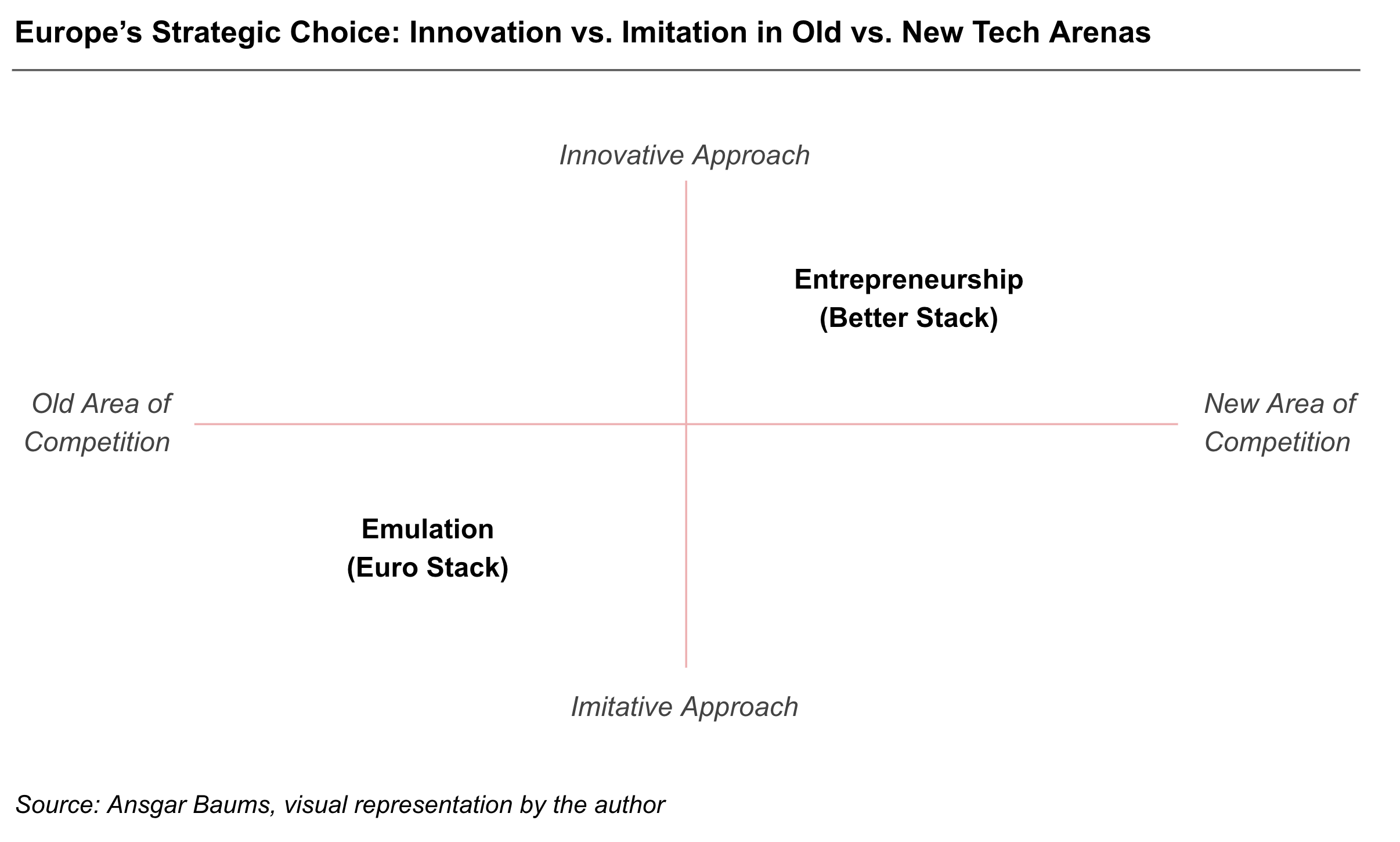
The moats that matter are born in the top-right quadrant: Innovative bets aimed at future value chains: If Europe wants to become indispensable within the Western IT stack, it must hold positions that others cannot route around. Those positions do not emerge from retrofitting or replicating what already exists. They emerge when firms move early into uncertain frontier domains, reach scale first, and set the standards, platforms, or bottlenecks that everyone else later depends on. Indispensability is a by-product of getting to the next paradigm before it hardens. The top-right quadrant is the strategic space where Europe can still create moats that translate into leverage, because the race has not yet been decided.
Take the example of ASML: The company did not become indispensable by producing a marginally better version of established lithography tools. It became indispensable by backing extreme-ultraviolet lithography at a moment when the outcome was technically uncertain and competitors preferred safer paths. That is how genuine moats form in increasing-returns sectors: not by copying incumbents, but by reaching the next paradigm first and locking it in.
The Euro Stack proposal, by contrast, sits in the bottom-left quadrant: An imitative strategy applied to existing value chains. Instead of asking where Europe can take commanding positions in the technologies that will define the next decade, Euro Stack thinking asks how Europe can recreate what the United States and China already dominate today. It is modernisation framed as grand strategy — a catching-up agenda presented as sovereignty.
This route cannot close Europe's moat deficit. Replicas are not moats. A European cloud that only Europeans use is a regional substitute, not a global chokepoint. It reduces dependency but creates no leverage. Sovereignty built on substitutes is defensive at best.
There is also a bitter irony here. SAP, one of the very few European firms that has built a genuine wide moat, has become a primary target within parts of the Euro Stack debate. The logic of Euro Stack would end up constraining some of the few companies that have achieved what Europe says it wants: durable, globally relevant strategic positions.
The Venture State: A New Governmental Logic to Support Moats
Europe’s Strategic Choice Graph above makes the challenge explicit. If Europe wants to close its moat deficit, it has to move into the top-right quadrant: Innovative strategies aimed at future value chains. That shift must be initiated by corporate actors, but it cannot be delivered by them alone. Moat-building in increasing-returns markets requires long horizons, scale pathways, and the ability to absorb uncertainty. The state is already in this game, whether it admits it or not. The question is whether Europe's governments continue to act like referees in yesterday's arena, or start operating like strategic venture actors in tomorrow's.
The state cannot fix corporate culture directly. But it can create the conditions, from scale pathways to risk absorption, that make moat-building strategies viable for European firms. This logic is what the Venture State describes. It is an entrepreneurially-acting state adapted to increasing-returns competition: A state that systematically builds options in frontier value chains and scales winners fast enough to create moats. This is not an argument for ‘small government’. A government capable of supporting moat formation must be competent, well-resourced, and deeply embedded in technological realities. What must change is not necessarily the size of government, but its shape: From reactive stabiliser of the present to proactive builder of strategic positions.
The Venture State follows four principles:
Principle 1: States Are Technology Actors — Either Intentionally or Passively
States are unavoidably co-authors of the technological landscape through public procurement, regulation, R&D funding, infrastructure, standards, and security policy. The Venture State begins by acknowledging this fact and treating it as a strategic asset rather than an embarrassment.
In frontier races, the worst posture is passive neutrality. If you do not place bets, you are not staying out of the market; you are allowing others to shape the market you will later depend on.
Principle 2: Option-Building Beats Plan-Building
The second principle is the operational core. Breakthroughs in AI, compute, materials, or energy systems follow power-law dynamics: a handful of winners define entire eras. That means no committee can reliably pick the winner ex ante. The rational response is option-building: place many early bets under uncertainty, accept that most will fail, and scale the ones that show traction.
This is venture logic applied to statecraft. It replaces linear industrial policy with an adaptive portfolio of strategic options. Institutions modelled on ARPA and DARPA, the US defence research agencies that seeded the internet, GPS, and the foundations of modern AI, embody this logic in practice: They run many high-risk projects in parallel, expect failure, and promote only the few that open new technological paradigms.
Principle 3: Scale Pathways Are Part of Sovereignty
Moats do not form at the invention stage; they form at the scale stage. A Venture State therefore treats demand and deployment as strategic tools, not afterthoughts. It connects frontier bets to concrete scale pathways: lead markets, testbeds, compute and energy infrastructure, and early anchor customers.
In increasing-returns sectors, scale is not a reward for success. It is the precondition of success. The state's job is to compress the time from promising technology to irreversible ecosystem position.
Principle 4: Share Upside Where Frontier Risk Has Been Taken
If public institutions absorb early-stage risk and create scale pathways, they should also be structured to capture a share of the upside, not as a revenue grab, but as a sustainability mechanism for future bets. This is where the Venture State overlaps with what Mohammed Soliman, Senior Fellow at the Foreign Policy Research Institute, has called the Portfolio State: governments behaving like strategic shareholders in moat-critical sectors.
Modern venture systems recycle gains into new option-building. Without that recycling logic, the Venture State becomes fiscally fragile and politically brittle. The state that takes risk should also take part in successes, be it through equity or other forms.
The Venture State in Practice — And What Europe Must Learn From It
These four principles are not theoretical. The United States, China, Japan, and the Gulf states provide examples of how this logic is put into practice: placing parallel bets, building scale pathways, and converting public risk into strategic ownership. The difference between them and Europe is not capability, but intent. Europe has the resources. What it lacks is a shared doctrine that treats moat-building as a legitimate aim of statecraft.
First, states are already technology actors (Principle 1). The United States does not treat semiconductors, minerals, or clean tech as neutral market domains; China has never pretended they are; Japan actively curates its indispensable niches; and the Gulf states are shaping AI infrastructure as a sovereign project. The difference is not whether the state intervenes, but whether it does so intentionally to build future leverage.
Second, they show why option-building beats plan-building (Principle 2). None of these actors is betting on a single pathway. CHIPS, IRA and ARPA/DARPA form portfolios of parallel frontier bets; China seeds multiple contenders per strategic chain and lets scale dynamics reveal winners; Japan persists across a range of specialised materials and tools until bottlenecks harden; and Gulf sovereign funds are spreading large-scale bets across compute, power, cloud, and models. In power-law environments, these portfolios are the only rational way to hunt for future moats.
Third, every case demonstrates that scale pathways are part of sovereignty (Principle 3). The United States links frontier R&D to guaranteed demand and domestic scale; China uses massive home-market scale and protected learning curves; Japan builds dominance by compounding scale in narrow yet globalised segments; and the Gulf states are manufacturing scale directly through sovereign capital in compute-and-energy infrastructure. In all cases, scale is treated not as a reward for innovation, but as the mechanism through which innovation becomes an irreversible advantage.
Finally, the examples underline why states that take frontier risk increasingly seek frontier upside (Principle 4). The United States shift from subsidies to equity in Intel and MP Materials is the clearest embodiment of Portfolio State logic; China’s guided funds and state shareholdings institutionalise the same principle; Japan’s long-term industrial backing effectively socialises early risk to secure later strategic rents; and Gulf sovereign funds are explicitly converting public wealth into ownership positions in future chokepoints. The pattern is consistent: where governments see moats as geopolitical assets, they also design ways to recycle gains into the next round of bets.
Conclusion: Shape the Future or Be Shaped by It
The geopolitical order is being rewritten by those who bet early and broadly. The Venture State is already how major powers start to operate. Germany and Europe must adopt this logic or accept strategic irrelevance.
This is not an argument for big government in the traditional sense. A government skilled enough to support moat-building is not necessarily large, but it must be differently shaped. It requires deep industry expertise, risk tolerance, and operational agility that European public institutions currently lack.
The choice is simple: build a portfolio of venture bets that shapes the future — or be governed by the bets of others.