
Reading the Law to Read the State: What Nearly 500 Regulations Reveal About Ukraine's Digitalisation
Ukraine's GovTech Reform Index, by Vox Ukraine and GGTC Kyiv, scores digitalisation regulations quarterly. Based on 487 regulatory acts assessed so far, it shows how a wartime state builds digital infrastructure and where implementation lags.
The Challenge
Ukraine's digital state is well known abroad, from the Diia app and portal to its climb from 75th to 1st place in the UN E-Participation Index between 2018 and 2024. Yet digital transformation needs more than apps: it needs a robust, high-quality regulatory foundation. Amid war and accelerated EU integration, Ukrainian institutions must track whether digital regulations adopted by many government bodies are technically and legally feasible.
Since early 2025 , the joint analytical team of Vox Ukraine and GGTC Kyiv, navigating through the hundreds of regulations being adopted each month, has identified 487 new digitalisation-related regulations, most of them adopted by the Cabinet of Ministers. Policymakers, donors and businesses need to know which acts create something genuinely new, which merely adjust procedures, and which the state can actually implement.
Without a consistent answer, gaps might be unnoticed: the 'Active Parks' platform and mobile app have operated since 2021, while a specific legal digital framework was adopted in 2026.
The Solution
The GovTech Reform Index is a quarterly, expert-based assessment of the regulations that shape Ukraine's digital state. For more than a decade, Vox Ukraine has tracked and evaluated changes in national legislation through its flagship Reform Index. The Index builds on a retrospective baseline: the Reform Radar review of more than 100 acts adopted in 2019–2024.
The main beneficiaries are government teams, which get an external signal on their regulatory pipeline; international partners, which see where support is most needed; businesses, which learn early about new obligations; and civil society, researchers and journalists, who gain an evidence base for public debate.
Independence As a Core Governance Principle
Every act is scored on three questions: how digitally innovative it is, whether the state has the resources to implement it, and how long its impact is likely to last? The scores capture the potential of the changes a regulation introduces, not how they are implemented in practice.
Scoring is done by an independent Expert Council, an interdisciplinary and cross-sectoral body of experts. Government officials do not sit on it, and experts with a link to a specific act do not assess it. The methodology, the quarterly reports and the full list of assessed acts are public.
The Index is also a communication and public-enlightenment project. For each volume, the team publishes social media posts explaining in plain language what new rules change, and actively shares the releases with public officials, GovTech practitioners, universities, students and international institutions. The open list of Expert Council members and their published comments give visibility to the experts' knowledge and help build a community of like-minded professionals committed to change.
What the Data Shows
Six quarters reveal patterns no single act shows. The graph below breaks the Index down into its three criteria. Implementation feasibility (orange line) shows the experts' assessments of whether the state has the resources, people, and systems needed to put a regulation into a practice. Ambition and feasibility tend to trade off, but not always.
In the first half of 2025, acts were more innovative but harder to implement; in the second half, detailed secondary legislation made implementation easier but innovation fell (Volume 2). The 2026 scores are close to their best levels at once, which lifted the Index to its highest values to date.
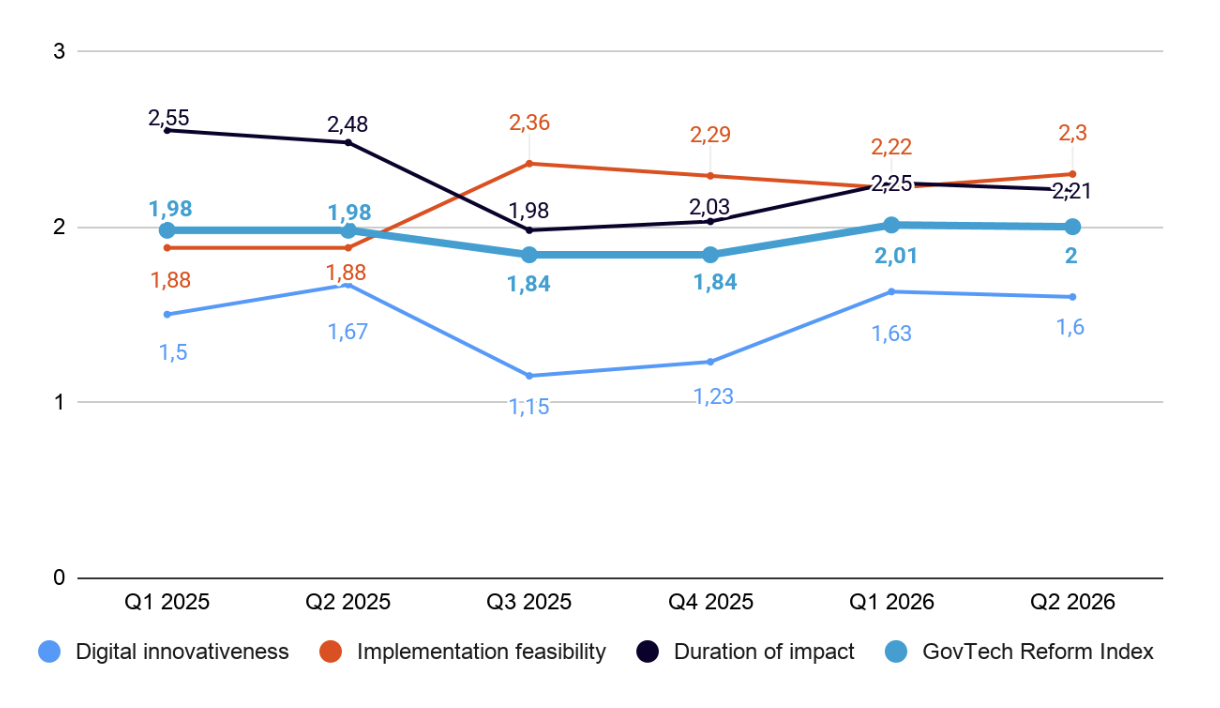 Graph. Average scores by evaluation criterion
From Digital Services to Digital Infrastructure
The top-scoring act of the entire series (2.83) is a national repository of cyber incident data. Other highly rated acts include a National Carbon Registry and a geographic information system that traces agricultural exports to plot level for the EU deforestation rules.
Existing Infrastructure Streamlines Implementation
Feasibility scores are highest where acts build on systems already in place — the Trembita data-exchange platform, Diia or the State Agrarian Register, which now automatically verifies farmers' eligibility for export-duty exemptions instead of relying on certificates from the Chamber of Commerce and Industry.
EU Integration Driving Regulatory Change
Several highly rated acts implement EU rules — DORA-aligned security requirements for the financial sector, the EU deforestation regulation, electricity market coupling — and a wave of cybersecurity acts in late 2025 brought Ukraine closer to the Network and Information Security Directive 2 (NIS2).
Limits and Scalability
Because the Index assesses potential rather than outcomes, transparency is essential: anchored scoring scales, median aggregation and published comments keep expert judgment open to scrutiny, and linking scores to later implementation data is a logical next step. The Index does not yet measure equity and inclusion directly, although experts note, for instance, whether a digitalised procedure keeps a paper option.
The Index uses only public documents, processes no personal data and needs no specialised technology. That makes it portable: any country, region or sector with an open legal database and a pool of independent experts can adapt the approach to their own context. It complements, rather than competes with, global maturity indexes such as the World Bank's GovTech Maturity Index or the UN E-Government Development Index: they measure the stock of digital government every few years, while the Index tracks the flow of rules that change it.
Lessons for Others
The Ukrainian experience suggests four lessons:
Measure the flow, not only the stock. Quarterly scoring of new rules gives an early signal — one that multi-year rankings of digital couldn’t.
Assess feasibility separately from ambition. The gap between what a regulation promises and what the state can deliver is often a useful finding.
Start with a baseline. A review of past legislation gives the first results context.
Make measurement understandable. Plain-language explanations and open expert engagement can turn the technical index into a shared resource and a community that keeps the conversation about reform going.
The GovTech Reform Index is supported by the Swiss-Ukrainian EGAP Program (East Europe Foundation) and the Askold and Dir Fund (ISAR Ednannia, funded by Norway and Sweden).