Seamless by Design: How Finland is Delivering Zero-Touch Public Services
What if government services just happened – without forms, queues or even login? Finland is redefining public service delivery with a zero-touch approach, a model in which services are automatically triggered around life events and delivered with little or no user interaction.
Moving Past Digital Saturation to Proactive Public Services
By the early 2020s, Finland had achieved what many countries aspire to: a high level of digital maturity. Most public services were available online, the use of digital identities was widespread, and interoperability between government systems was well established. Citizens had become accustomed to digital convenience, and trust in public institutions remained high.
But despite this progress, a fundamental question remained. Citizens still had to take the first step to access services. They had to know when to apply for benefits, update their information across multiple agencies, or make contact for services to which they were entitled. The public sector had digitised its processes – but the logic of service delivery had not fundamentally changed.
This raised an important question: What comes after digitisation? As Mikko Mattinen, Director of Finland's Digital and Population Data Services Agency, put it:
"Digitisation is saturating. Many services have been digitised. So the next big question is: how can we serve our people even better?"
Rather than simply digitising more forms or building more portals, Finland recognised that real progress lay in eliminating avoidable interactions altogether. The vision that emerged was to move from a user-driven model to one in which services are delivered automatically, based on known life events and trusted data sources, without citizens having to request or even be aware of the underlying processes.
This approach became the foundation for zero-touch services: a model where citizens receive public services seamlessly, without needing to navigate administrative procedures or initiate contact with authorities.
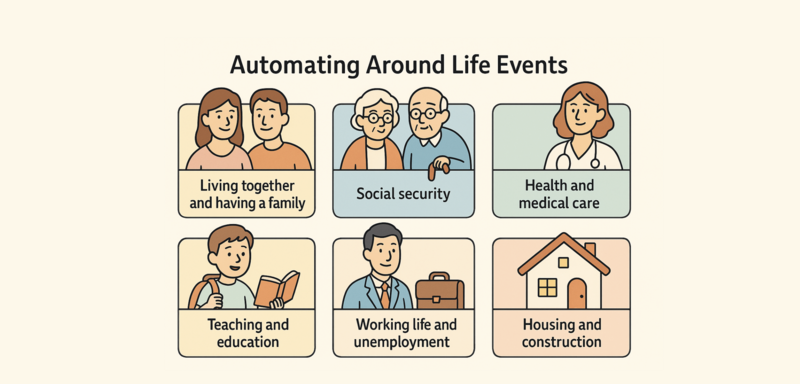
Zero-Touch Government Services: Automating Around Life Events
Finland's Zero-Touch Government Services idea represents a new approach to the delivery of public services: At its core, the model is based on a simple but powerful idea: when a key event occurs – such as the birth of a child, reaching a certain age, moving to a new address or the death of a family member – the government already has the necessary data to initiate the relevant services. Rather than waiting for citizens to apply, the government can proactively deliver what is needed.
The development of zero-touch services builds on two main pillars:
- Life event-based service bundles, which group services around key moments in life to make government easier to navigate.
- Data-driven life events, where interoperable data flows between agencies allow services to be triggered automatically without requiring user input, like for example easing the management of the affairs of a deceased relative.
Progress is already being made in several areas. In areas such as passport renewal and national ID issuance, biometric data provided for previous documents is reused, eliminating the need for new applications. Business registration has been streamlined to a near one-click experience through strong authentication and pre-populated data. And in taxation, most citizens now receive pre-populated income tax returns that require no action if the data is correct – around 50% of Finns accept their return without making any changes.
The ambition goes even further: to create a model where citizens receive the services they are entitled to automatically, without having to interact with government systems at all. When implemented effectively, the zero-touch approach not only reduces bureaucracy and speeds up service delivery, but also strengthens inclusion, improves the citizen experience and increases operational efficiency through the intelligent reuse of trusted digital infrastructure.
Rewiring the Public Sector for Proactive Service Delivery
Foundations: Rethinking Governance, Data, and Organisational Roles
Finland's move to zero-touch services requires not just technical change, but a rethink of how government services are structured and delivered.
At the heart of this shift is a simple but profound reversal: services are no longer initiated by citizens, but proactively triggered by the government based on life events and existing data. This new service logic challenges long-established ways of working, where public sector organisations have traditionally built processes, IT systems and staffing models around receiving applications and requests from citizens.
In a zero-touch model, the government anticipates needs rather than responding to them. Services are no longer developed in isolation by individual agencies, but are designed around major life events such as birth, marriage, moving house, starting a business, or death. This requires close collaboration between agencies that have traditionally worked separately. Life events, rather than organisational structures, become the new organising principle for service delivery.
This approach also aligns closely with the goals of the EU Digital Compass 2030, which sets a European target for key public services to be available online and organised around life events, making interactions more seamless for citizens across EU Member States. The Finnish model anticipates and advances this vision at the national level.
This shift is also changing the role of civil servants. Instead of processing individual requests, their work is increasingly focused on designing seamless service journeys, maintaining data quality, managing event triggers and ensuring legal and operational coherence across multiple agencies. Service design expertise, cross-functional teamwork and agile development methods are becoming essential skills.
Finally, public trust is recognised as a prerequisite for success. Automation only works if citizens trust the systems behind it. Finland therefore combines proactive service delivery with high levels of transparency: citizens can see the data held on them and are notified when services are triggered. The principle is clear: the more invisible the service, the more visible the accountability.
Delivery Mode: From Application to Automation
Building zero-touch services requires a gradual and pragmatic approach to implementation. Rather than trying to transform everything at once, Finland is focusing on redesigning services around the most impactful and common life events first. Life events are selected based on two criteria: their importance to citizens and their potential for automation.
Pilot projects, such as the development of a fully automated 'life and death' service bundle, demonstrate the model in action - integrating data for example from the population register, tax administration, banks and insurance companies to automatically handle key matters when a person dies, without the need for multiple separate notifications from the family.
Importantly, the Finnish delivery model emphasises collaboration over formal mandates. Agencies work together on the basis of shared goals and mutual benefit, rather than relying on top-down enforcement. This pragmatic culture of collaboration, built over decades of digitisation work, is proving to be a key enabler of progress.
Technology: Infrastructure That Enables, Not Just Supports
Finland's zero-touch model is based on a robust digital infrastructure: At its core is the Population Information System, a real-time, continuously updated national registry that contains authoritative data on individuals, addresses, family relationships and vital events such as births and deaths. This system acts as a single source of data, enabling life events to be identified immediately and relevant services to be triggered across government.
To move data securely and efficiently between organisations, Finland uses a data exchange layer which is developed based on the X-Road technology. It is not a centralised database, but a decentralised, encrypted network that allows public and private sector systems to exchange information through standardised, secure interfaces. Every data transaction is logged, enabling transparency and auditability - a critical safeguard in a zero-touch environment where services operate without direct user involvement.
Suomi.fi e-Identification provides strong, trusted authentication when user confirmation is required, ensuring that automated services can still securely involve citizens when necessary. In addition, Suomi.fi Authorisations allows citizens to delegate rights digitally, for example allowing family members to manage services on behalf of others.
Finland's digital architecture is modular and API-driven, allowing new services to plug into the existing infrastructure without having to rebuild core components. By building a decentralised but tightly interoperable infrastructure, the government enables services to respond to changes in the real world – rather than relying on citizens to initiate contact. This technical design turns the vision of a proactive, invisible government into a working reality.