Smarter Safety: How Germany’s BG BAU Uses AI to Prevent Workplace Accidents
How BG BAU turned AI into a practical tool for smarter inspections and accident prevention in the construction industry, with measurable results in months.
The Challenge of Targeted Prevention in a High-Risk Sector
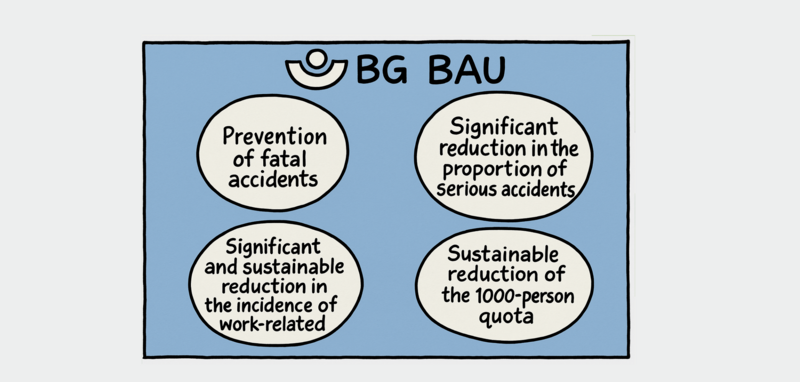
As in all other countries around the world, the construction sector in Germany is among the most hazardous, with high rates of occupational accidents and serious injuries. BG BAU is the statutory accident insurance provider for the construction industry in Germany and is responsible for over 600,000 companies and more than three million insured individuals. Prevention, not just compensation, is central to its remit.
However, with a limited capacity of around 500 field inspectors, BG BAU faces a key operational challenge: how to prioritise inspections in areas where they are most needed to prevent serious workplace accidents.
Traditionally, inspections followed a fixed rotation and relied on manual indicators that were sometimes outdated. Resources were distributed evenly, regardless of actual risk. Inspectors were also burdened with paperwork, spending up to 30 minutes per inspection writing reports, amounting to an estimated total of 9,000 workdays annually. Consequently, time and attention were often misallocated: lower-risk firms were visited while high-risk sites were overlooked.
Recognising this mismatch between risk and resources, BG BAU and the Federal Ministry of Labour and Social Affairs (BMAS) launched a new initiative to shift from reactive to predictive prevention, and to do so quickly, without increasing inspection capacity. The question was: how could AI help deliver smarter safety?
An AI Application for Targeted, Risk-based Accident Prevention
This challenge has been met with a concrete solution: an AI-powered tool designed to assist case inspectors in focusing their efforts where they can have the greatest impact. Known internally as 'KI-basierte Unterstützung für zielgenaue Unfallprävention' and launched in 2023, the system is built around an AI model that has been trained using over 10 million data points, including inspection records, claims data, legal infractions, and company histories. The system identifies companies with the highest likelihood of occupational safety issues and updates its risk predictions weekly.
Each week, inspectors receive a prioritised list of firms in their region, ranked according to their predicted need for advisory support. The list includes brief explanations for each flag, enabling inspectors to understand and assess the underlying risks. This approach supports, rather than replaces, professional judgement, helping inspectors to tailor on-site advice to specific situations.
The system also incorporates recent developments. For example, if an inspector flags a major safety violation anywhere in the country, this information is incorporated into the current week’s scoring. This enables real-time, dynamic prioritisation, which was not possible under the previous, rotation-based model.
"It is not about doing more. That was never the goal. We did not want to inspect more companies, but rather the right ones, and to help our inspectors focus their advice where it is needed most."
— Ellen Hellmann, Consultant for Digitization and Project Manager, BG BAU
The tool uses a human-in-the-loop approach: the AI indicates where and why to look, but the final decision rests with the inspectors. This design has led to widespread internal adoption: 95 percent of inspectors use the tool weekly, and targeted interventions at high-risk sites achieve a success rate of 65 percent.
From Vision to Reality: In Less Than a Year
Foundations: Trust, Alignment and Organisational Readiness
The challenge at BG BAU was never one of competence or infrastructure. The organisation already had what many still strive for in place: two decades of structured digital records; a trusted in-house IT provider, BG Phoenics; political backing from BMAS; and the right in-house expertise. However, there was no clear strategy for utilising this infrastructure more effectively and shifting from uniform oversight to targeted prevention.
In 2023, BG BAU began developing the tool as part of the Network AI in Labour and Social Administration, which is coordinated by the BMAS and in line with Germany’s national AI strategy. From the outset, the tool was conceived as a practical, operational solution to improve the prioritisation and execution of inspections, rather than as a research pilot. The project received €3.5 million in federal funding from the BMAS, reflecting its potential as a scalable model for the responsible use of AI in public administration.
Leadership support was central to the project's success. As the project addressed the organisation's core mandate of preventing workplace accidents, it quickly became a strategic priority and attracted ministerial attention from the BMAS. This visibility helped secure buy-in from across the organisation, ensuring sustained executive-level backing from the outset.
The initiative was also characterised by robust internal alignment, which was developed and sustained over time. Key stakeholders, including field inspectors, legal advisers, IT teams, and prevention experts, were involved from the outset and throughout the process. This extensive engagement enabled the project to progress from concept to deployment in under a year, ensuring the solution was integrated into daily practice.
Delivery Mode: Agile Development, Embedded Practice
The project was implemented using an agile, sprint-based development model. Every two weeks, a cross-functional team comprising data scientists, occupational safety experts, legal advisors, and inspectors met to integrate user feedback directly into the system design. The inspectors played an active role in shaping the interface, refining risk indicators, and stress-testing the system against real-world scenarios.
Pilot testing began in mid-2023. By December, the solution had gone live nationwide and was fully integrated into the weekly routines of field inspectors. Thanks to the system’s modular design and seamless integration with existing workflows, no additional infrastructure or staffing was required. Training and onboarding were structured to encourage adoption, incorporating live coaching, practical use cases, and visible feedback loops. Since the launch of the AI tool until now, the impact has been clear:
Over 4,000 inspections have been carried out for companies that had not previously been flagged.
The success rate in high-need cases has risen from 35 percent to 65 percent.
61,000 hours have been reallocated from paperwork to prevention.
EUR 250 million in projected savings from avoided accidents and claims.
"We deliberately did not think in terms of support processes, but focused on defining the greatest impact AI could have on our core task: reducing accident burden."
— Jakob Kort, Head of Digital Transformation & International Cooperations, BG BAU
Technology: Modular, Secure, and Ready to Scale
The solution is based on a random forest supervised learning model. All training data is pseudonymised and extracted from a dedicated analytical layer built on 20 years of digitised records, ensuring compliance with strict data minimisation and German data protection regulations. The system is hosted on-premises and secured with role-based access controls, full audit trails, and external audits. Technical development was led by BG Phoenics, BG BAU’s in-house IT provider, in collaboration with an external IT partner selected through a targeted procurement process.
Importantly, the current setup is designed as a flexible AI infrastructure, rather than a one-off application. Its modular, cloud-ready architecture provides a shared foundation for additional use cases, including planned applications in rehabilitation, compliance, and fraud prevention. This establishes the system as a scalable AI platform within the public sector that is capable of supporting multiple domain-specific models while remaining interoperable with other government IT systems.
The system has moved beyond BG BAU; other statutory accident insurers in Germany have adopted AI use cases, establishing the approach as a scalable model throughout the German social protection ecosystem. There is also growing international interest, with preliminary collaborations underway in Japan, Brazil and the United Arab Emirates.