
What Is Holding Governments Back?
This article is co-authored by Simone Maria Parazzoli, Consultant, World Bank, and Luukas Ilves, Advisor, Government of Ukraine, and former Chief Information Officer, Estonia.
After the publication of The Agentic State vision paper last October, governments have started exploring what it would take to move from vision to deployments. Excitement is high, but the blockers are real. There are seven consistent gaps holding progress back. But as those gaps have come into sharper focus, so too have promising ways to close them.
Launched last October, The Agentic State vision paper offered a speculative but serious attempt to rethink government for the era of AI. The paper described a system-level shift across all layers of government, from service design and procurement to governance and tech stack, and argued that increasingly autonomous AI systems could bring a step-change in state capacity and public value.
Since then, the authors have spent months in dialogue with governments to understand what it would take to make that vision real. These conversations spanned all continents, from Australia to Brazil, from Canada to Estonia, to Germany, Ghana, Iceland, Indonesia, Italy, Japan, Serbia, Singapore, Sweden, the UAE, the UK, Ukraine, the US and many more. The response was enthusiastic: governments are securing funds, early agentic deployments are taking place, and several countries are publicly signalling their intention to build towards their interpretation of the Agentic State vision.
But when the question shifted to what is blocking progress and what would actually help teams move from vision to pilots and then to sustained transformation, the conversations got serious and the list of inhibiting hurdles got longer.
What follows is an attempt to distil these conversations and share a current list of what governments are missing: the practical knowledge products, tools, and shared building blocks that come up again and again.
What Governments Need
The strongest demand signals revolve around seven needs:
- Use-case prioritisation
- Reference architectures
- Standards and interoperability
- Model benchmarks
- Operational governance frameworks
- ROI and funding
- Organisation and talent
1. Use-case prioritisation. Governments lack practical frameworks for deciding which tasks and workflows are ready for agentification and which are not. The goal is to rule out poor candidates before teams invest months in pilots. A useful lens can be the task model: governments run thousands of repeated task sequences across ministries and silos. If we can identify the most horizontally diffused tasks and workflows and the ones most amenable to safe automation, the agentification of one will have multiplied impact, accelerating progress toward the Agentic State.
2. Reference architectures. Governments need technical blueprints. Reference architectures for common patterns — public-facing agents, internal workflow agents, compliance agents — with clear guidance on identity, permissions, logging, escalation, and oversight hooks. Without this, every team rebuilds the same surrounding machinery from scratch (or just asks the Ukrainians how Diia.AI works and copies what they can). The fastest way forward is to learn from the earliest experiments, publish patterns, and iterate in the open. A bottleneck today is that even industry actors are not fully sure what to standardise around. Uncertainty is worrying for governments, but it also implies the opportunity to shape what is possible.
3. Standards and interoperability. As agents begin to interact with public services at scale, fragmentation becomes a systemic risk. Governments need guidance on shared protocols — for agent IDs, permissions, logging, and tool schemas — and a concept of the machine-facing state: official, authenticated channels that citizen and firm agents can use safely, before third-party agents quietly capture the ‘front door’. The risk of flooding is real: if interfaces are not designed for agentic access, they will still be accessed by agents — just badly, noisily, and without control. Governments should generously participate in cross-sectoral bodies where standards are being shaped and tilt the market mandating non-proprietary protocols in procurement and interactions.
4. Technical benchmarks. Governments do not know which models to use, nor how models will perform on their real work. Generic LLM and agent benchmarks do not map to government casework, eligibility reasoning, fraud detection, regulatory workflows, or citizen communications, and, in general, they fail public sector requirements. What is missing are evaluation methodologies tailored to actual public-sector tasks. The deeper issue is that we are still far from a mature science of evals, especially for agents. In this context, the best suggestion is painfully simple: test in context. At deployment level, things take a whole different flavour — or better, they finally take flavour. Pick a task and define what success looks like. Take a sample of 100 instances of the task, use an agent to run 50, run the other 50 with your status quo method. Compare.
5. Operational governance frameworks. Governments already have ethics principles. What is missing is the operational layer: risk frameworks tailored to agentic behaviour, practical models for appeals and contestability, including a shift from governance-as-approval to governance-as-instrumentation (monitoring, logging, auditability, escalation, recourse). If an agent shapes a consequential outcome, citizens need a meaningful way to understand, question, and challenge it. Some research and government teams are exploring this seriously. The detailed operational tools do not exist yet.
6. ROI and funding. The agentic transition needs to speak the language of centre-of-government budgets, not only of poorly-funded innovation teams. Governments need ROI tools that reflect public value: time-to-service, error reduction, fraud reduction, burden reduction, staff capacity unlocked. They need model tender language, evaluation criteria, co-development templates, and contract clauses that prevent vendor lock-in, enforce audit access, and align incentives with measurable outcomes. They need to translate the resources required for the agentic transition into investment and procurement plans that finance ministries can approve. The uncertainty of innovation sits in tension with the predictability government budgets demand. No one has cracked how to navigate that well.
7. Organisation and talent. The agentic state transition fails without the right structure: shared platforms, teams, centres of excellence, and clear new mandates and roles. How should government organisations evolve? In these organisations, governments need engineers and people who can talk the language of both policy and code who can deploy safely in real institutions. How to find these people? Or how to train them?
Governments also expressed other needs. Even if the signal seems less strong, very useful work could come out of them. Governments are also asking about:
- Evaluation standards for pilots. Shared templates and standards that help define success beyond anecdotes, distinguish model failure from process failure, and build the evidence base needed to justify scaling, combining technical evals with policy-relevant ones.
- Sovereignty-aware deployment patterns. Many governments treat sovereignty as non-negotiable. How do we build the Agentic State in a way that provides strict control over data, auditability, and strong performance?
- Readiness assessment. Governments want to know what will break first if they start now. Global assessments of readiness are needed to put in place clear efforts to get in shape. The 12-layered Agentic State framework can be a useful lens.
What Supply Needs to Be Built
Taken together, these demand signals point to a missing transition infrastructure: the portfolio of enabling products that would make it easier for governments to move from curiosity to deployment.
Not all of these enabling products sit in the same place. Some are better understood as global public goods: things that can be built once, improved in the open, and reused across many countries. Interoperability standards, reference architectures, benchmark suites, pilot evaluation methods, international learning infrastructure, and readiness diagnostics largely fall into this category. Others require more localisation and tailoring to specific circumstances. Specific use-case prioritisation, procurement and contracting models, sovereignty-aware deployment patterns, and talent support depend much more on legal context, institutional structure, budget processes, legacy systems, and political priorities. These can benefit from shared methods, but they cannot simply be copied and pasted across countries.
To reflect on how these demands might best be addressed, we mapped the possible enabling products across two dimensions: strategic versus operational, and global versus local. The diagram below shows the result. We first identified 13 possible products and ecosystem-services based on the demands discussed above. We then tasked five AI agents running on Opus 4.6 to impersonate distinct personas — a finance ministry director, a digital transformation lead, a citizen rights advocate, a technical architect, and a frontline caseworker. We asked each agent to assess the products along both axes, and then calculated the average.
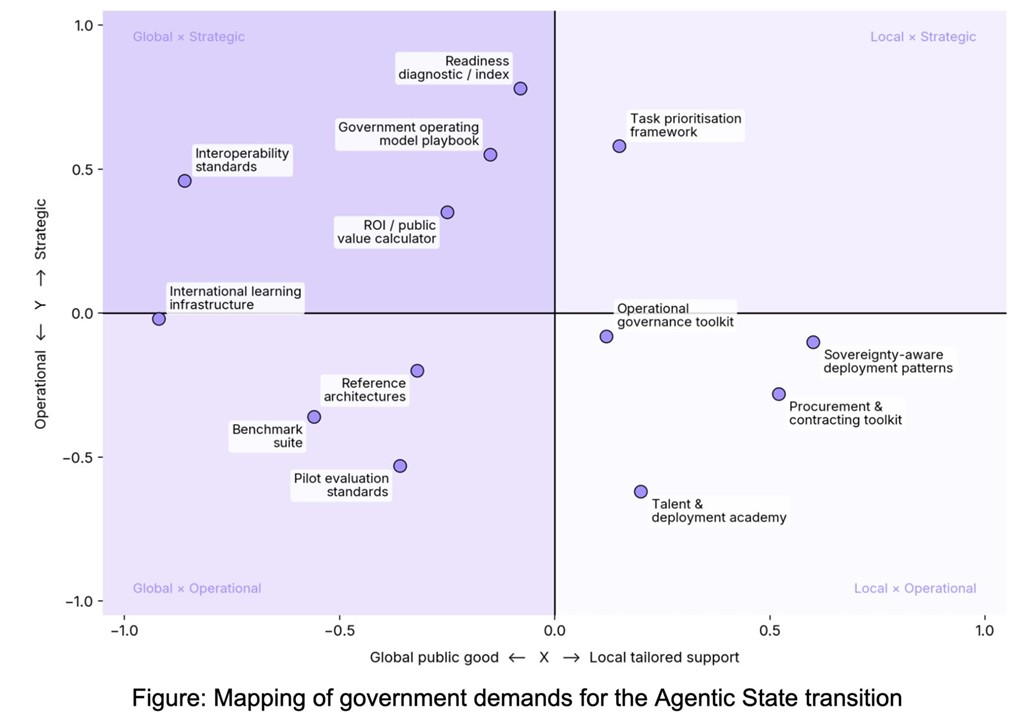
Figure: Mapping of government demands for the Agentic State transition
Obviously we do not present this as a substitute for a global strategy. But it proved a useful reflection exercise to flesh out what can be done in the international arena, and appreciate that there is a lot that can be done to make governments progress towards the Agentic State.
Where We Go from Here
Governments are experimenting in parallel, with limited mechanisms to reuse each other’s lessons. Compound learning about what works (and what does not) is the scarcest resource right now, and working in the open is the best way to build it. But there is no shared place to accumulate what is working, what has been tried, and what is failing.
A living repository of deployments, evaluation results, and reusable patterns would let learning compound across countries instead of resetting every time. A living community of government builders that collaborates, shares failures and successes, and creates the peer pressure and support that makes change happen. An horizontal layer that connects governments willing to accelerate their adoption of agentic AI.
The list of needs presented here is a snapshot of the demand signal emerging from governments, along with current hypotheses about what will unlock the transition from the vision of an Agentic State to successful deployment and transformation. If you are a government team, researcher, builder working on any of this, your pushback is welcome.
Which gaps hurt most in practice? What is missing? Which artifacts would you actually use next quarter? Which ones should be global public goods and which require tailored collaboration?
The community around agentic AI in government is moving fast and growing. If you are working on any of these problems, we want to learn from and with you.
The fastest path to the Agentic State is not one country getting it right in isolation. It is many countries learning in parallel, and sharing the building blocks that make that learning compound.
The views expressed in this article are those of the author(s) and do not necessarily reflect the views of the World Economic Forum. The content was provided by the contributing organization and is shared to encourage dialogue and the exchange of diverse perspectives. The World Economic Forum remains impartial and does not necessarily endorse any political views or specific language used.