From Data to Trust: How Medellín is Making Environmental Education and Local Action Transparent
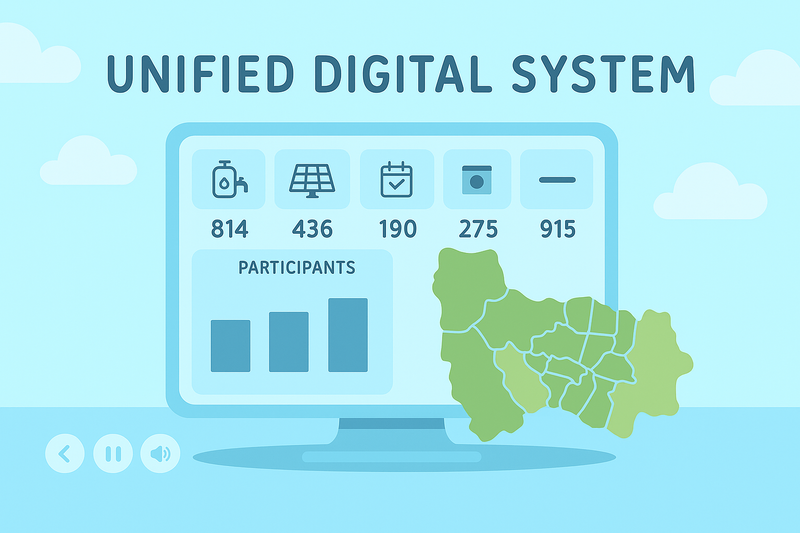
Medellín’s Secretariat of Environment uses a unified digital system with KoboToolbox and Power BI to monitor and display data on environmental education and sustainability projects, boosting transparency, citizen trust, and accountability in participatory budgeting initiatives citywide.
Participatory Budgeting for the Environment: Medellín’s Path to Community-Led Sustainability
Since the early 2000s, Medellín has embraced Participatory Budgeting (PB) as a way to involve citizens directly in the allocation of public funds at the local level. Every year, communities in the city’s communes and corregimientos vote to prioritise projects that address their specific needs. This mechanism, rooted in Colombia’s 1991 Constitution and institutionalised in Medellín through public policy in 2007, reflects the city's commitment to strengthening democracy, equity, and territorial development by ensuring that a portion of public spending is decided by the people.
Within this broader strategy, the Secretariat of Environment, responsible for defining and implementing environmental policies and strategies aimed at the conservation and sustainability of natural resources, has implemented community-based environmental initiatives funded by PB. These include educational workshops on sustainability, the creation of ‘sustainable households’ through the installation of eco-technologies (such as composting systems, water harvesting units, and energy-saving devices), and campaigns to promote responsible consumption and waste reduction. Through PB, these actions have been tailored to the specific needs of each territory, fostering environmental awareness and citizen engagement across Medellín.
In those communities where the environmental actions were not prioritised, the Secretariat executes environmental activities as well, according to the prioritisation carried out by the Development Plan of the District and the analysis made by the Secretariat.
Before 2020, the implementation of these PB-funded environmental initiatives faced coordination and accountability challenges. Contractors were selected through public bidding processes, and although they were required to report their activities, this reporting was typically done through presentations or deliverables shared directly with the community, using whatever format each contractor deemed appropriate. The Secretariat of Environment did not receive this information in a standardised or systematised way, which made it impossible to consolidate data across projects or territories.
As a result, the Secretariat lacked a complete and centralized understanding of what was being implemented, how resources were being used, and what outcomes were being achieved — limiting both strategic planning and transparency. Moreover, the fragmented and inconsistent nature of the data made it difficult to extract insights or lessons learned that could inform future interventions or improve program design at the city level.
A Unified Digital System for Transparent Environmental Action
In 2020, the Secretariat of Environment partnered with the University of Antioquia — who had previously served as a contractor in some communes and was already familiar with the program’s operations — to design a comprehensive and centralised solution. This collaboration marked the transition from scattered implementation to a unified model, formalised through an inter-administrative agreement between two public institutions. The new approach aimed to ensure greater consistency, technical standardisation, and cost efficiency by replacing the previous system based on multiple independent contractors.
As part of its work as a contractor, the University of Antioquia had already been using KoboToolbox — a data collection, management, and visualisation platform — to collect field data from the activities it executed. The platform proved useful for capturing structured and georeferenced information — even in offline conditions — using mobile devices. Building on this experience, the University proposed adopting KoboToolbox more broadly as the standard tool for data collection across all PB-funded environmental education initiatives. Recognising its potential to unify and digitise field operations, the Secretariat decided in 2021 to formally adopt the tool as its official data collection system.
With this decision came the need to build internal capacity. The Secretariat, along with the University of Antioquia, carried out training processes for both public officials and field contractors. These trainings included instruction on how to use KoboToolbox forms in the field, how to ensure consistent data quality, and how to access and interpret the information collected. This process laid the groundwork for a more autonomous and technically competent institutional team. Then, in 2023, the Secretariat acquired its own enterprise license to ensure full ownership and control over the information gathered — extending its use to all environmental initiatives, regardless of funding source.
Today, more than 250 field staff are contracted annually to execute activities and use KoboToolbox during an intensive four-month implementation period, typically in the second half of the year. Each person uses their own mobile device to collect real-time data on actions such as workshops, eco-gardens, and citizen engagement efforts. The use of a single, institutional form ensures that data is standardized, traceable, and centralized across the entire district.
In parallel, the University had also been using Power BI to visualise the data it collected, presenting progress and insights through dynamic dashboards. Once the Secretariat adopted KoboToolbox, it also embraced Power BI as the visualisation tool of choice — leveraging the city’s existing Microsoft Office license to operate the dashboards under the Secretariat’s own account. This decision ensured that the Secretariat had direct access and control not only over the data being collected but also over how it was presented and analyzed.
The Power BI dashboard — developed by the University using the Secretariat’s license — is directly connected to KoboToolbox forms, enabling automatic updates and real-time visualisation. It displays georeferenced data disaggregated by territory, type of activity, and key indicators, allowing technical teams and decision-makers to monitor implementation, identify gaps, compare performance across communes, and support evidence-based planning. It is also published on the Secretariat’s official website, giving citizens access to explore which actions were implemented in their communities, how many people participated, and what results were achieved. Based on internal feedback, the dashboard’s interface has been gradually improved to enhance clarity, usability, and data navigation.
The transition to this model has also brought administrative and financial benefits. The inter-administrative agreement with the University of Antioquia — already experienced in executing similar initiatives — replaced a model based on public bidding that often brought in contractors with varying levels of expertise. In doing so, the Secretariat achieved cost savings of 19 percent from VAT exemption and an additional 10 percent by eliminating administrative and profit margins typical of private contracts. Centralising execution and data management under one institutional framework has allowed for improved planning, streamlined reporting, and a more efficient use of public resources.
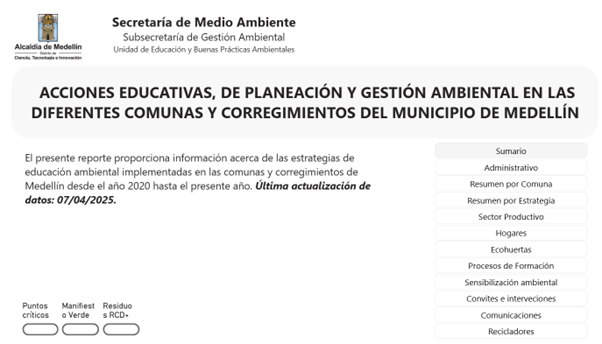
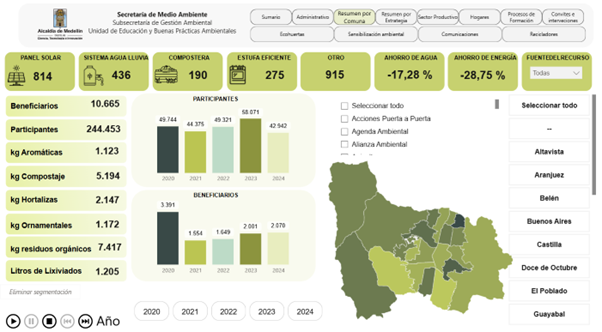
Images sourced from the Secretaría de Medio Ambiente de Medellín, illustrating the platform’s interface.
Data-Driven Trust: Transforming Environmental Governance
This system has boosted the Environmental Secretariat’s role as strategic manager of environmental education and sustainability efforts. With access to detailed, real-time insights, they can now identify which territories need greater support, which actions generate the highest engagement, and how to better allocate resources. This has enabled more targeted interventions and strengthened the alignment between community needs and public action.
Beyond internal improvements, the platform has fostered a culture of openness and collaboration. It has empowered citizens not just to vote on environmental priorities, but to track how those priorities materialize over time. Community members can see tangible progress in their own neighborhoods. This visibility has deepened civic trust and helped transform environmental programs from isolated events into sustained, collective efforts.
This growing trust is also reflected in citizens' increasing participation: while in 2020 only six communes prioritized environmental initiatives through Participatory Budgeting, by 2025 that number had more than doubled, with 14 communes allocating resources to these efforts.
On the institutional side, the Secretariat now has access to a level of information that was previously unattainable. In the past, contractors would present isolated reports to each community, and the data would remain buried in folders, unanalyzed and disconnected. Today, data is consolidated across the district, allowing the Secretariat to identify not only which neighborhoods they’ve reached, but also those where impact has been limited or absent. In Commune 6, for example, PB funds are consistently prioritized for environmental education, yet the dashboard has revealed specific neighborhoods within the commune where results remain insufficient. It has also made visible where the same actions have been repeated with limited effect. We can now say that these insights now inform the design of more adaptive and responsive interventions.