
Kyiv Digital: Operating a City-Level Digital Public Infrastructure Interface Under Sustained Disruption
Kyiv Digital, a city-level digital public infrastructure interface, integrates services and official communication to reduce fragmentation and support continuity of municipal operations during prolonged disruption.
From Fragmented Services to the Need for a Unified Digital Experience
Kyiv, home to almost four million residents, manages a wide range of municipal services spanning transport, utilities, safety, administrative services, and civic participation. Historically, these services operated through separate departmental channels, each with distinct interfaces, processes, and communication mechanisms. As a result, residents were required to navigate multiple websites, applications, and communication channels to manage everyday interactions with the city. For municipal authorities, this fragmentation created operational silos, limited visibility across services, and slower coordination.
These challenges were not rooted in the absence of digital tools, but in the lack of a unifying city-level digital interface. Residents faced fragmented access to services and information, while the municipality lacked a single, trusted channel through which it could reliably communicate service updates or operational guidance at scale.
While these structural constraints had been recognised prior to the onset of sustained disruption, they became significantly more consequential under stress conditions. Rapidly changing service availability and operating constraints increased demand for timely, official information, while municipal departments operated under limited capacity. Without a consolidated digital access point, both residents and city authorities faced increased operational friction and reduced predictability in service delivery.
In this context, the core challenge was both institutional and operational: how to provide residents with predictable access to essential municipal services and official information through a city-operated digital channel, while enabling more effective coordination across municipal operations under prolonged stress conditions.
Building a City-Level Digital Public Infrastructure Interface
In response to these challenges, the City of Kyiv established Kyiv Digital as a city-operated digital public infrastructure interface, owned and operated through the municipal administration. Strategic oversight, service prioritisation, and accountability remain within local government, ensuring alignment with public policy objectives and public service mandates.
Since its launch in 2021, the Kyiv Digital app has become the city’s primary resident-facing digital entry point, providing a consistent and recognisable interface for municipal interactions. Today, it serves the majority of the city’s residents, reaching a level of adoption that allows it to function as a default digital entry point for high-volume municipal interactions. Rather than operating as a standalone application for individual services, Kyiv Digital was conceived as a unifying interface that standardises how residents access city services, while allowing flexibility in how underlying systems evolve over time.
The initial implementation focused on public transport and mobility—one of the most frequent points of interaction between residents and municipal services. This high-volume use case provided a practical foundation for broader expansion, establishing delivery patterns and technical capabilities that could be extended incrementally as new services were added.
As the platform evolved, the City of Kyiv deliberately differentiated resident-facing channels based on usage patterns. While the Kyiv Digital app concentrates on high-frequency and high-transactional interactions, services that require extensive documentation, longer processing times, or infrequent engagement are delivered through a dedicated Kyiv Digital Services Portal, launched in 2024. Together, these channels form a coherent city-level digital ecosystem, optimised for different types of service interactions.
The solution operates at the local (municipal) level of government and primarily contributes to the development of digital public infrastructure, while also supporting digital service delivery, citizen–government communication, and municipal operations.
From the outset, Kyiv Digital was designed to address several interrelated objectives, including:
reducing fragmentation in resident access to municipal services,
establishing a clear and trusted digital communication channel,
improving coordination across municipal departments, and
supporting continuity of municipal operations under changing conditions.
In practice, this approach has enabled simplified resident access, more consistent communication, and improved operational coordination across services.
Equity and inclusion considerations informed both the design and rollout of the solution. By consolidating services and official communications into a single city-operated interface, Kyiv Digital aimed to reduce barriers created by complex administrative structures and multiple entry points. Accessibility features, including screen reader compatibility and simplified navigation, support use by people with disabilities, while offline functionality ensures that critical information remains accessible even when connectivity is disrupted, reinforcing the principle that essential municipal information should remain available under adverse conditions.
Implementing Kyiv Digital: Governance, Architecture, and Delivery
Kyiv Digital is governed as an official municipal function, with governance arrangements defining ownership, decision rights, and accountability within the city administration. This structure enables coordination across departments while maintaining compliance with municipal policies, ensuring that the solution operates as an extension of city operations rather than as a standalone technology initiative.
Delivery relied on internal municipal capabilities, including product ownership, service coordination, technical management, cybersecurity, and agile project delivery. Cross-departmental coordination mechanisms supported alignment between resident-facing interactions and back-office operational capacity.
From a technical and architectural perspective, Kyiv Digital was implemented as an interface layer that integrates existing municipal digital infrastructure rather than replacing it. Kyiv Digital does not function as a full service-orchestration platform in the technical sense. Instead, it operates as a resident-facing interface that brings together services delivered through multiple underlying systems. This integration-first approach preserved prior investments, reduced duplication, and enabled incremental capability expansion.
At the national level, Kyiv Digital ecosystem favours existing state digital public infrastructure rather than duplicating it. Where relevant, the city leverages services such as the Diia digital identity (Diia ID), Diia electronic signature, and state document exchange services for verification of government-issued documents, including driving licenses. This approach allows Kyiv Digital to remain focused on city-level service access and coordination, while relying on nationally governed DPI layers for identity, authentication, and document trust.
Implementation combined in-house delivery with external technical support. External providers contributed to specific components, while strategic direction, integration decisions, and data stewardship remained under municipal control. Partnership arrangements were structured to maintain public oversight while enabling flexibility in development and deployment. Key stakeholders included municipal departments, city leadership, and residents, whose needs and operational realities informed prioritisation and service design.
The rollout followed an incremental, phased approach, with services added based on priority, readiness, and operational feasibility. This allowed the city to adapt to changing conditions without disrupting existing services. Performance monitoring focused on usage and scale indicators, including resident adoption and transaction volumes, which informed prioritisation and continuous improvement.
Implementation under sustained disruption introduced capacity, coordination, and integration challenges. These were addressed through prioritisation of essential services, simplified user journeys, and incremental integration rather than large-scale system replacement.
Kyiv Digital is built on a modular architecture that supports integration with multiple municipal systems, enabling new capabilities to be introduced without disrupting existing functionality and supporting both rapid adaptation and long-term stability. Security and data management are treated as foundational requirements, with measures in place to protect system integrity and resident data. Redundancy and offline capabilities further support continuity under adverse conditions.
Outcomes and Transferable Lessons
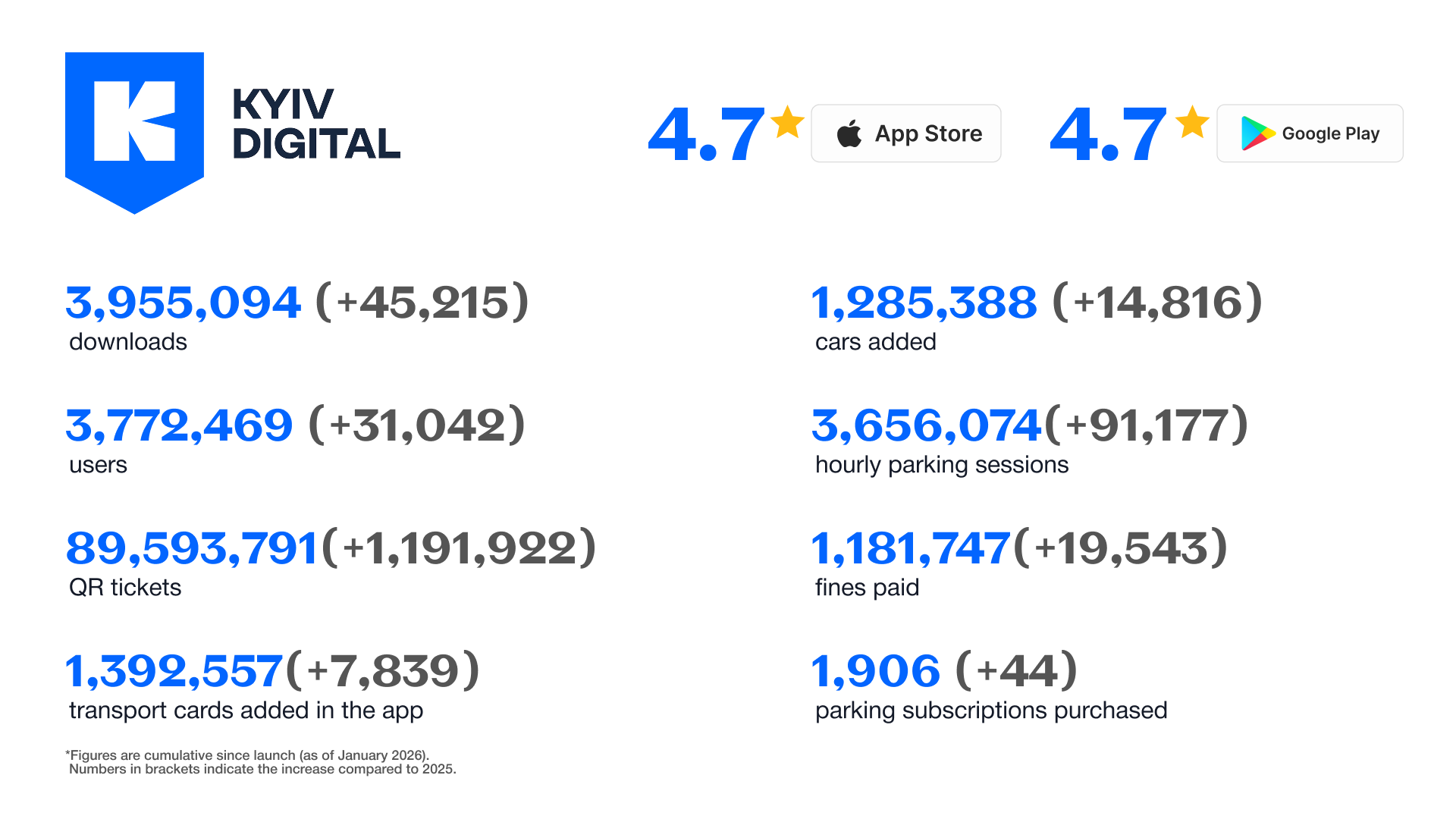
Kyiv Digital now functions as a unified access point for municipal services and official communications, supporting millions of residents in their daily interactions with the city. Usage and scale indicators demonstrate sustained adoption across multiple service categories, including high-volume public transport transactions and participatory civic tools.
The approach has also been referenced in international benchmarking exercises and recognised through a range of industry and public-sector engagements, including the UN Local Online Services Index (LOSI) and Smart City Expo World Congress.
Kyiv’s experience highlights several lessons that may be relevant for other cities seeking to strengthen digital service delivery and operational coordination.
1. Treat resident-facing digital access as infrastructure
Positioning digital access as a core operational interface supports continuity and coordination across municipal services.
2. Retain municipal ownership of the interface layer
City control over governance and integration is critical for cross-departmental alignment and long-term operational coherence.
3. Differentiate channels by usage patterns
High-frequency and transactional interactions benefit from lightweight interfaces, while document-intensive services require dedicated environments. Together, these interfaces can form a coherent city-level digital ecosystem, allowing residents to interact with municipal services through channels designed for different usage patterns.
4. Design for backend evolution without user disruption
A stable resident-facing interface enables underlying systems to evolve incrementally, reducing the need for disruptive large-scale replacements.
5. Enable orchestration without premature replacement
As service complexity increases, cities may need to strengthen service-orchestration capabilities across multiple systems and providers. Kyiv’s experience suggests that establishing a stable resident-facing interface can create the conditions for such orchestration to evolve over time, without requiring immediate replacement of legacy systems.
In this article, “Digital Public Infrastructure” is used in a layered sense. Kyiv has developed its own municipal digital infrastructure to operate and integrate city services and communications under sustained disruption. Where nationally governed DPI components exist and are fit for purpose (for example, national identity, electronic signature, or state-level data exchange), Kyiv integrates and uses them rather than duplicating functionality. Kyiv Digital therefore operates as the city-level interface and integration layer across both municipal and national digital rails.