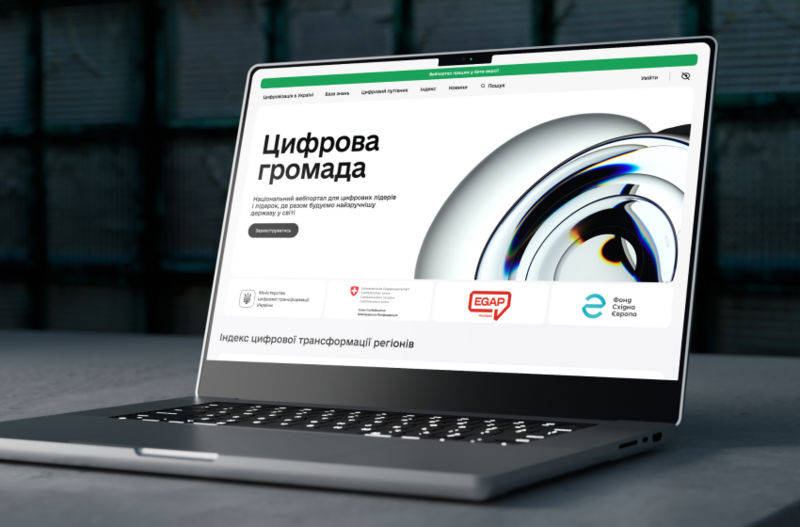
Diia.Digital Hromada is a national web platform designed to unlock opportunities for digital leaders within regional and local government bodies. The web platform aims to involve roughly 1469 digital leaders from the local government bodies, 24 CDTO from regional military administrations and provide the access to e-cabinet among digital leaders to develop their skills and knowledge. Moreover, the web platform is a vivid example of adopting data-driven decision making, as it includes several methodologies to track current digital transformation in Ukraine’s regions and communities. The Ministry of Digital Transformation, specifically its Regional Digitalization Unit, is responsible for supporting the Diia.Hromada web platform.
Empowering Communities with User-Centric Technology
Diia.Digital Hromada web platform was created in response to longstanding challenges in local and regional government operations. Traditional administrative processes were often outdated, lacking the agility and digital infrastructure necessary for rapid public service delivery. This GovTech solution was developed to meet the need for: enabling government officials to become proactive drivers of digital transformation; reducing bureaucratic inertia by integrating digital tools and data-driven decision-making; providing a more responsive, transparent, and efficient public sector that can better address citizens’ needs.
The web platform is aimed at supporting decentralization, which began in 2014. Within the framework of decentralization, it is planned to create an association of communities in accordance with the European Charter of Local Self-Government. Although the reform has already strengthened local self-government, further development of communities requires new innovative-technological solutions. Diia.Digital Hromada web platform helps to coordinate digital transformation in regions and communities, to address current challenges, and to present new digital solutions.
The Ukraine’s President presented the 'State in an App' in 2019 which prompted a rethinking of public governance in Ukraine. According to a public poll, ~99% of Ukrainians use the internet, which makes the web platform the most accessible and convenient tool for interaction with citizens. The creation of the Diia.Digital Hromada web platform is a step in complementing the Diia ecosystem and in directly providing regional and local state administrations, local self-government bodies, and citizens with the information necessary for digital development and transformation at the regional and local levels. The digital transformation of regions and communities is primarily necessary for providing quality public services, ensuring access to cellular communication and fixed internet, as well as for improving the level of cybersecurity and the functioning of critical infrastructure.
Modernizing Local Government
The web platform is integrated with the national electronic identification system. For user authorization, an integrated electronic identification system (ID.gov.ua) is used, which supports Diia ID, BankID, MobileID, and a qualified electronic signature. This ensures unambiguous identity verification upon logging into the portal, and also meets the requirements for personal data protection. User personal data is protected, and the web platform has a conformity certificate of a comprehensive information protection system.
Diia.Digital Hromada has the potential to enhance ongoing local digital transformation, more specifically:
- Measuring the level of digital transformation of each community and region through the Regional Digital Transformation Index and the Territorial Communities Digital Transformation Index
- Providing methodological recommendations for the implementation of digital solutions locally and highlights the best practices of state digital solutions
- Experience exchange in rolling out digital solutions at the local government level
- Helping communities independently manage digitalization, raising the level of digital maturity and more.
Verifiable benefits through the system
Implementation of the web platform assists to support the digital transformation of regions and communities through a single platform. Over several years after the introduction of the CDTO (Chief Digital Transformation Officer) position, a significant increase in the number of digital leaders in territorial communities has been observed. Now more than 1088 digital community leaders have joined the Diia.Hromada web platform as of April 2025. This means that most communities have designated a responsible official for digital development in the local self-government body. All regional CDTOs are on the same wavelength and have access to information about state digital initiatives. Such consolidation of efforts significantly increased the efficiency of digital transformation at the local level and demonstrated the success of the chosen partnership model. Furthermore, digital transformation indexes on the portal are monitoring tools of the current level of digitalization and the growth zones for each community.
Partnerships and Procurement
The Diia.Hromada web platform is created by the Ministry of Digital Transformation of Ukraine with support from the Swiss-Ukrainian EGAP Program, implemented by East Europe Foundation.
During the beta stage, the platform was continuously updated with materials and shortcomings were corrected. This ensured that the product quality met the requirements and that all parties remained satisfied with the result. A customized product was implemented by the Ministry based on the actual requests of communities. This ensured a high compliance of the portal's functions with the needs of the target audience.
Rollout Strategy
The deployment of the Diia.Hromada web platform solution followed a phased approach. Initially, the platform was launched in a pilot mode. Today, the Ministry of Digital Transformation of Ukraine is working on development of new functionalities of the web platform.
Core Technological Components
The web platform is integrated with the national electronic identification system. For user authentication, an integrated electronic identification system (ID.gov.ua) is used, which supports Diia ID, BankID, MobileID, and a qualified electronic signature. This ensures unequivocal identity verification upon login to the portal, as well as compliance with personal data protection requirements. Thus, the Diia identification services (in particular, the citizen account and the Diia.Sign electronic signature) are integrated into the portal, allowing officials to securely access its functions. Moreover, the web platform includes a data analytics panel with interactive dashboards to display quantitative information about the digital transformation in 24 regions and all communities of Ukraine.
Security and Data Management
Among the main security measures the web platform contains a comprehensive information protection system; electronic identification; validation of entered data (data type, value, format) on the web platform; encryption of information stored in the database; access management (permission/denial/handling of access); role management (for example, password validity period, account blocking, use of a secure SSL connection); constant review of all security technologies and innovations for their further implementation, etc.
Digital Future for Every Community
The Diia.Hromada web platform is designed with scalability in mind, facilitating its adaptation across various regions, departments, and contexts within Ukraine. It offers a comprehensive Digital Guide that presents three tailored pathways for digital transformation- basic, extended and advanced level to provide recommended projects and detailed roadmaps, enabling communities to select and implement solutions that align with their specific needs. Also, the web platform provides an extensive knowledge base for digital leaders, including educational materials, research, best practice guidelines, and normative documents to drive digital transformation.